
When planning an undergraduate application in Japan, it is easy to wonder whether a strong JLPT result can stand in for the EJU. The Examination for Japanese University Admission for International Students (日本留学試験(EJU)) and the Japanese-Language Proficiency Test (日本語能力試験(JLPT)) serve different purposes, so neither is a universal substitute for the other. Start with the requirements of each university you are considering.
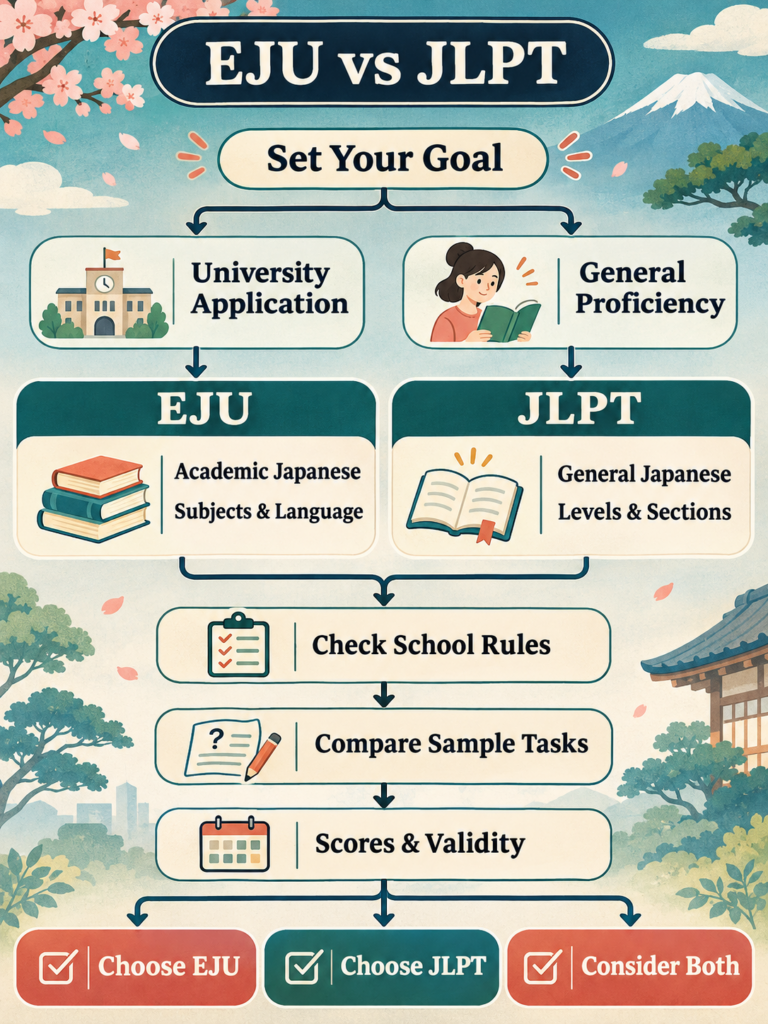
For EJU vs JLPT, the key distinction is what each test measures: the EJU assesses academic Japanese (アカデミック・ジャパニーズ) and can include academic subjects, while the JLPT measures general Japanese-language ability (一般的な日本語能力). The comparison below explains how their formats, difficulty, scoring, and admission uses differ, so you can decide whether to take one or both.
- EJU vs JLPT: Which Test Should You Take?
- EJU vs JLPT: What Each Test Measures
- EJU vs JLPT for University Admission: Check Each School’s Rules
- EJU vs JLPT Difficulty: Why N1 Does Not Equal an EJU Score
- EJU vs JLPT Scores, Passing, and Validity
- How to Choose Between Taking the EJU, JLPT, or Both
- Conclusion
- Sources and Further Reading
- Frequently Asked Questions
EJU vs JLPT: Which Test Should You Take?
When a University Application Points to the EJU
Choosing between the EJU and JLPT can feel like choosing between two measures of the same skill, but the tests serve different purposes. The Examination for Japanese University Admission for International Students (日本留学試験(EJU)) is designed for international applicants seeking undergraduate study in Japan. The Japanese-Language Proficiency Test (日本語能力試験(JLPT)) measures general Japanese proficiency. The right choice depends on your next goal.
If a Japanese university application names the EJU, that test is usually the relevant one to plan for because it can assess Japanese alongside academic subjects. A school may request the Japanese as a Foreign Language test, subject tests, or a combination, depending on the program. For example, an applicant to a science program may face different subject requirements from an applicant to a humanities program. Each school sets its own rules.
An EJU result is a score rather than a pass-or-fail certificate, so the school uses it according to its own admissions process. A strong JLPT result may show general language proficiency, but it does not automatically provide the academic evidence an EJU requirement is designed to collect. Identify your main goal and check whether your target school names either test. That check can prevent preparing for the wrong exam.
| Comparison | EJU | JLPT |
|---|---|---|
| Purpose | Undergraduate study in Japan | General Japanese proficiency |
| Skills assessed | Academic Japanese and selected subjects | Language knowledge, including characters, vocabulary, and grammar |
| Result format | Scores; no pass-or-fail result | Pass or fail by level |
| Admissions role | Used when a school requests it; subjects vary | May document proficiency; school decides |
The EJU is more directly linked to undergraduate admissions because it can measure academic Japanese and subject knowledge. The JLPT provides a general proficiency result, so its role depends on what a school accepts. Neither test has a universal admissions effect.
The table shows why the exams are not interchangeable. A university applicant can use the EJU when a program requires it, while a learner seeking a general certificate may prefer the JLPT. Individual schools set their own rules.
When the JLPT Fits Your Language-Proficiency Goal
Choose the JLPT when your main aim is to document general Japanese proficiency rather than meet a specific EJU admission requirement. It is organized into levels from N5 through N1, so a result communicates a defined proficiency band. That makes it a useful general benchmark for learners who are not applying to a Japanese undergraduate program. It measures a different profile from the EJU.
The JLPT tests language knowledge such as characters, vocabulary, and grammar. Unlike the EJU Japanese test, it does not include writing questions. That difference matters if you want to show written academic Japanese, a skill the EJU assesses but the JLPT does not. The JLPT can still suit a learner whose main goal is a general proficiency result.
Some learners may have reasons to take both, but one test does not replace the other automatically. The JLPT can document general ability, while the EJU can address academic Japanese and subject requirements for university applications. If you are considering undergraduate study, the school’s listed requirements determine whether a JLPT result is enough or whether EJU scores are needed.
EJU vs JLPT: What Each Test Measures
EJU Japanese and Its Academic Subject Choices
The Examination for Japanese University Admission for International Students (日本留学試験(EJU)) is designed for people applying to undergraduate programs in Japan. It measures Japanese for academic study, or academic Japanese (アカデミック・ジャパニーズ), alongside basic academic skills. In other words, it covers academic Japanese alongside subject knowledge, rather than language ability alone. That distinction matters when a program asks for both language and subject results.
The subject choices are Japanese as a Foreign Language, Science, Japan and the World, and Mathematics. Applicants select subjects based on their target school’s requirements, so the EJU is not one fixed bundle of tests for every student. Science and Japan and the World cannot be taken in the same session. The EJU is available in Japanese or English overall, but its Japanese as a Foreign Language test is administered only in Japanese.
The Japanese test includes writing, reading comprehension, listening, and listening-reading comprehension. JASSO reports the combined reading and listening score on a 0–400 scale and the writing score on a 0–50 scale. These tasks assess skills used in academic settings, including understanding material and producing a written response. List the subjects and test language options required by your intended program.
| EJU option | What it covers | Language or session note |
|---|---|---|
| Japanese as a Foreign Language | Writing, reading, listening, listening-reading | Japanese only |
| Science | Academic subject test | Cannot be combined with Japan and the World in one session |
| Japan and the World | Academic subject test | Cannot be combined with Science in one session |
| Mathematics | Academic subject test | EJU offered in Japanese or English |
The EJU subject list is a set of options, not a requirement to sit every test. Applicants choose subjects according to the requirements of their target school, and the Science and Japan and the World tests are mutually exclusive within one session.
The language choice also has a limit: although the EJU is offered in Japanese or English, the Japanese as a Foreign Language test is only in Japanese. This means the English option applies to the relevant EJU tests, not to the Japanese test itself.
How the JLPT Tests General Japanese Proficiency
The Japanese-Language Proficiency Test (日本語能力試験(JLPT)) measures general Japanese-language ability (一般的な日本語能力), rather than readiness for a particular university subject combination. It has five levels, from N5 through N1. The test assesses language knowledge such as characters, vocabulary, and grammar, as well as reading and listening. The formats differ.
Unlike EJU Japanese, the JLPT does not include a writing section. Candidates do not produce written responses as part of the JLPT, while EJU Japanese includes writing alongside reading, listening, and listening-reading comprehension. This distinction matters if you are comparing test preparation: recognizing vocabulary and grammar is not the same task as composing a response in Japanese.
Neither test is a direct substitute for the other. JASSO says EJU and JLPT scores cannot be accurately equated because the exams assess different content and use different question types. A JLPT result therefore does not predict your EJU Japanese score or measure your performance in EJU academic subjects. The table compares their content and language options, not which test is harder.
EJU vs JLPT for University Admission: Check Each School’s Rules
What to Verify in Each Program’s Admission Requirements
A school’s published admissions rules determine which results count. A JLPT certificate alone does not establish that an EJU requirement is waived. Schools decide whether to use EJU scores, which subjects to require, and whether to combine them with other screening. Rules can differ by program, so a university-wide overview may not answer the requirements for a particular degree.
Look for the exact program and applicant category in the guidelines. The wording may say that EJU scores are required, name specific subjects, or describe another screening method. If the EJU is required, its Japanese test may not be enough: the program could also require Mathematics or Science or Japan and the World. These are program-specific requirements, not universal subject rules.
Open each target school’s current admissions guidelines and record its required tests, subjects, and eligible sessions. JASSO says EJU scores are valid for two years, covering the four most recent sessions, but schools may set their own eligible sessions. The program’s rules determine which results it will consider.
| Guideline wording | What it may indicate | Requirement to verify |
|---|---|---|
| EJU required | EJU scores form part of screening | Required subjects and eligible sessions |
| JLPT accepted | JLPT results may meet a language requirement | Whether JLPT replaces any EJU requirement |
| Alternative screening offered | Another selection route may be available | Who qualifies and which tests remain required |
The table shows why a short phrase in an admissions guideline is not enough to determine which test to take. A JLPT option may concern Japanese proficiency without removing an EJU requirement for academic subjects or other screening.
Requirements can differ by program and applicant category. The decisive details are the tests named, the subjects specified, and the sessions the school accepts.
When a School May Accept JLPT Results Instead
A JLPT result may be an alternative in some cases, but acceptance depends on the school’s rules. JASSO notes that some schools may use JLPT scores for applicants from places where the EJU is not offered. This does not mean every program offers that option, or that an N1 or N2 pass automatically replaces an EJU score.
The wording in the admissions guidelines matters. “JLPT accepted” could refer to evidence of Japanese proficiency, while a separate EJU requirement may still apply to academic subjects or other parts of screening. A school that accepts JLPT results instead may still require another test or selection method; the exact conditions vary by program.
A JLPT certificate does not automatically replace EJU scores when a school uses the EJU. The JLPT measures general Japanese ability, while the EJU is designed for applicants to higher education and can include academic subjects. A substitution is relevant only when the school’s stated rules provide for it, so the test names alone do not establish what an applicant needs.
EJU vs JLPT Difficulty: Why N1 Does Not Equal an EJU Score
Academic Japanese, Writing, and Listening Tasks
The two exams can feel difficult for different reasons. JASSO says EJU and JLPT scores cannot be accurately equated because the tests assess different content and use different question types. EJU vs JLPT difficulty is therefore not a single scale: a result on one test does not establish a matching result on the other. The EJU Japanese test focuses on academic Japanese (アカデミック・ジャパニーズ), so study-oriented language is part of the comparison.
The EJU Japanese paper combines reading comprehension (読解), listening and listening-reading comprehension (聴解・聴読解), and writing questions (記述問題). JASSO reports the reading and listening components together on a 0–400 scale, with writing scored separately from 0–50. This split matters: a learner who reads well but struggles to organize written responses faces a different challenge from someone whose main difficulty is understanding spoken material.
The tasks can also require following information and expressing ideas in ways that a general proficiency test does not measure in the same format. That does not make the EJU automatically harder; the experience depends on which skills are stronger for you and how familiar you are with academic language. Compare sample questions from the test your school requires before choosing a preparation plan.
JLPT Language Knowledge and General Proficiency
The JLPT measures general Japanese-language ability rather than academic Japanese for university study. JASSO describes its focus as language knowledge (characters, vocabulary, and grammar) alongside general proficiency. That is a different demand. For example, a learner may be comfortable with grammar and vocabulary questions but less prepared to write a clear response or follow study-related material.
The JLPT does not include a writing section, while writing is part of the EJU Japanese test. Its result therefore cannot show how a test taker would perform on the EJU writing tasks. A JLPT N1 pass is evidence of performance at the highest JLPT level, but it is not an EJU score and does not establish an equivalent level on the EJU scale.
Difficulty depends on the learner’s strengths, not just a label attached to either exam. Someone who knows many characters and grammar patterns may find the JLPT format familiar, while academic reading, listening tasks, or written responses may be less familiar. Another learner may be more comfortable with those tasks than with the JLPT’s language-knowledge questions. The exams answer different questions about Japanese ability, so neither is a reliable shortcut for predicting the other’s result.
EJU vs JLPT Scores, Passing, and Validity
EJU Scores and the Two-Year Validity Window
EJU results are scores, not pass-or-fail outcomes. For its Japanese as a Foreign Language test, JASSO reports reading and listening components together on a 0–400 scale, while writing is scored separately from 0–50. These figures describe performance across test areas rather than assigning a JLPT level. They are reported components, not a conversion formula or a single pass mark.
EJU scores remain valid for two years, covering the four most recent test sessions, according to JASSO. This gives applicants a window to use earlier results, but it does not mean every school accepts every session within that period. A university can set its own eligible sessions for an application, so the score’s age and the program’s rules both matter.
A result can fall within JASSO’s validity period but still be outside a program’s accepted sessions. Check which past EJU sessions your chosen school accepts and confirm its score-submission rules. This matters when an application spans more than one exam session, since the school’s conditions determine which result it will review. The score report alone does not establish whether a particular university will accept it.
| Item | EJU | JLPT |
|---|---|---|
| Score or level | Reading and listening: 0–400 combined; writing: 0–50 | Five levels: N1 through N5 |
| Result | Score report; no pass-or-fail result | Pass or fail |
| Passing criteria | Not applicable | Overall threshold plus section minimums |
| EJU score window | Two years, covering the four most recent sessions | Not an EJU score window |
The EJU reports scores for test areas, including separate reporting for writing, and does not assign a pass-or-fail result. Its validity window covers four recent sessions within two years, although schools can set their own eligible sessions.
The JLPT instead reports one of five levels and a pass-or-fail outcome based on an overall threshold and section minimums. These formats serve different purposes, so compare the result type and the school’s accepted sessions rather than trying to convert one exam’s result into the other’s.
JLPT Levels, Passing Rules, and Section Scores
The JLPT reports results through five levels, N1 through N5, rather than using the EJU’s subject-score format. Candidates receive a pass or fail decision for the level they take. The level identifies the test taken, but does not provide a separate score for EJU writing or academic subjects. This makes a JLPT result useful as a proficiency credential, not a direct translation of an EJU score.
Passing depends on reaching the required overall score threshold and meeting the minimum score for each scoring section, according to the JLPT organizers. Total score alone is not enough. The section minimums are separate from the overall threshold, so a high total does not by itself guarantee a pass if a section falls below its minimum. The JLPT uses both conditions to determine the result.
For admissions, a JLPT pass and an EJU score communicate different information: one confirms meeting a level’s pass standard, while the other gives a performance score for university-related testing. Treating N1 as an EJU score would overlook differences in content and reporting. A program may ask for one, the other, or additional screening, so neither result alone defines every application outcome.
How to Choose Between Taking the EJU, JLPT, or Both
If Your University Requires EJU Scores
If a program requires EJU results, that requirement should guide your preparation, even if you already have a JLPT certificate. The EJU may also require subject scores, so your language preparation alone may not cover the application. A strong general Japanese result is useful, but it does not replace an EJU score when the school asks for one.
Make a test plan from your target schools’ requirements, then prioritize the exam that affects your application. Compare the required EJU subjects and any other screening steps across your programs. If they differ, your study plan may need to cover more than one subject combination; the relevant school’s rules determine what counts. That requirement sets the priority.
If You Need a General Japanese Certificate
If your main goal is to show general Japanese proficiency, the JLPT is the more direct choice. Its levels give you a clear target when a school, organization, or personal study plan asks for a particular certificate. For example, if an application names a JLPT level, preparing for that level addresses the stated language requirement without adding EJU academic subjects you may not need.
A JLPT certificate can also provide a structured goal when you are learning Japanese without applying to an undergraduate program. Choose the level that matches the requirement you need to meet, rather than treating the highest level as necessary for every purpose. If a school asks for a different test or a specific score, its instructions take priority over a general preference for JLPT.
If You Are Considering Both Tests
Taking both can make sense when an EJU-required university application is your priority and you also need a JLPT certificate for another purpose. The tests assess different things, so preparing for one does not fully prepare you for the other. For instance, EJU study may focus on academic reading and writing, while JLPT preparation addresses its own language sections and pass rules.
Plan the order around deadlines and the requirements that affect each application, rather than assuming one result will cover both. If your target programs require different tests, weigh each requirement against your available study time and decide which result is essential first. The JLPT can remain a separate goal, but it should not displace preparation for a required EJU score.
Conclusion
EJU vs JLPT is not a contest to win; it is a choice about what you need to demonstrate next. The right evidence is the evidence that fits your goal.
Make a short checklist of your target schools, then verify their latest test rules before registering. Choose for purpose.
Sources and Further Reading
- Japan Student Services Organization (JASSO) — www.jasso.go.jp
- Japan Student Services Organization (JASSO) — www.jasso.go.jp
- Japan Student Services Organization (JASSO) — www.jasso.go.jp
- Japan Student Services Organization (JASSO) — www.jasso.go.jp
- Japan Student Services Organization (JASSO) — www.jasso.go.jp
- Japan Foundation and Japan Educational Exchanges and Services (JLPT) — www.jlpt.jp
- Examination for Japanese University Admission for International Students (EJU) — www.jasso.go.jp
Frequently Asked Questions
- QCan an EJU score be converted to a JLPT level?
- A
No. JASSO says the EJU and JLPT assess different content and use different question types, so their scores cannot be accurately equated.
The EJU includes academic Japanese and writing, while the JLPT measures general Japanese ability. A score on one test does not establish a level on the other.
- QDoes passing JLPT N1 or N2 mean I can skip the EJU?
- A
Not if your chosen school requires EJU scores. A JLPT N1 or N2 pass does not normally replace a required EJU result.
Some schools may accept JLPT results instead in certain cases, including for applicants from places where the EJU is not offered. Confirm the accepted tests with each school.
- QCan I take the EJU in English?
- A
Yes, the EJU is available in Japanese or English, but its Japanese as a Foreign Language test is administered only in Japanese.
Check your program’s requirements before choosing a test language. The school may specify which subjects and language it accepts.
- QDo I need to take both the EJU and JLPT?
- A
It depends on your goals and each school’s screening rules. Take both only if the admission requirements or a separate proficiency goal calls for both.
For example, a school may require EJU scores while you also want a JLPT certificate for another purpose. Check the school’s rules before registering.