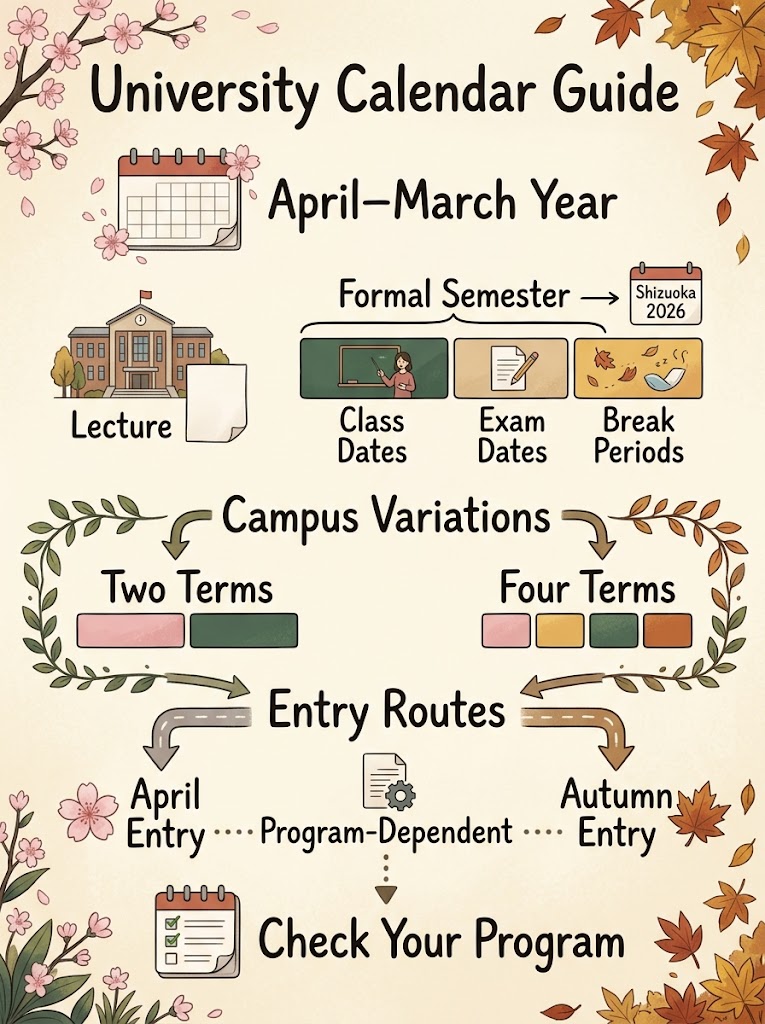
Japanese university semester dates often follow an April-to-March academic year, commonly divided into spring and fall semesters. The pattern is common, but dates differ by institution. Check the specific university calendar.
Official semester dates do not always match the weeks when classes meet. At Shizuoka University, the 2026 spring semester continues through September 30, while spring classes end July 31. Admission timing is a separate question. April is a usual entry point, but a fall semester does not guarantee September or October admission; options depend on the faculty, graduate school, or program. Understanding these differences helps when comparing calendars, planning travel, or deciding when to apply.
- Japanese University Semester Dates: The Typical Academic Year
- Japanese University Semester Dates Versus Actual Class Dates
- How Japanese University Semester Dates Vary by Institution
- April and Autumn Admission at Japanese Universities
- Japanese University Holidays, Exams, and Break Planning
- How to Confirm Exact Japanese University Semester Dates
- Conclusion
- Sources and Further Reading
- Frequently Asked Questions
Japanese University Semester Dates: The Typical Academic Year
Academic Year (学年): April 1 Through March 31
Japan’s academic year (学年) commonly follows an April-to-March cycle, rather than the September-to-August pattern familiar to many international students. Shizuoka University defines its academic year as April 1 through March 31, and Keio University describes April to March as its usual academic year. This is a useful starting point, but it is not a nationwide calendar rule.
In a typical pattern, April marks the start of the academic year, with classes continuing through the spring and early summer. Summer vacation often falls later in the year, followed by a fall term and a winter break. Classes and exams may then continue into the early part of the next calendar year, before the academic year ends in March.
The months give you a broad orientation, not a promise of when a particular class meets or when a break begins. Use the typical pattern to sketch your study or travel year, then compare it with your university’s calendar. That is the framework.
| Months | Common academic-year orientation |
|---|---|
| April–May | Academic year begins; spring classes often start |
| June–July | Spring classes and possible exams |
| August–September | Summer break may fall in this period |
| October–November | Fall classes often take place |
| December–January | Winter break may fall in this period |
| February–March | Classes or exams may continue; academic year ends |
The table groups the months into broad phases, but it does not set universal class or vacation dates. At Shizuoka University, for example, spring classes in 2026 are scheduled to end in July, while its formal spring semester continues through September.
A university may schedule exams, breaks, or classes differently from this outline. Use it to understand the general April-to-March rhythm, then rely on the calendar for your institution and program for exact dates.
Spring Semester (前学期) and Fall Semester (後学期): The Usual Split
Many universities divide the academic year into a spring semester (前学期) and a fall semester (後学期). At Shizuoka University, the formal spring semester runs from April 1 to September 30, and the fall semester runs from October 1 to March 31. The terms describe the academic calendar, but they do not mean classes run continuously across every month.
The semester dates and teaching schedule can differ. Shizuoka University’s 2026 spring classes are scheduled from April 13 through July 31, even though the formal spring semester continues until September 30. Its spring final exams are scheduled for July 27–31. This gap between the last scheduled class and the semester’s formal end is one reason to check both sets of dates.
Some universities also use different boundaries. Ritsumeikan University sets its spring semester from April 1 to September 25 and its fall semester from September 26 to March 31; some of its graduate schools use four quarters instead. So a fall semester can begin before October, depending on the institution. Check the calendar for your specific university and program.
Japanese University Semester Dates Versus Actual Class Dates
Shizuoka University’s 2026 Spring Semester Schedule
Shizuoka University’s formal spring semester runs from April 1 to September 30, 2026, according to the university’s academic calendar. That span defines the semester, but it does not mean classes meet continuously throughout those months. The gap between the formal boundary and the teaching schedule is useful to keep in mind when arranging an exchange or study visit.
At Shizuoka University, spring classes are scheduled to begin April 13 and end July 31, 2026. The university lists final examinations for July 27–31, so the exam period overlaps the last scheduled week of classes. In other words, the class-period end date does not mark a separate period after all examinations have finished.
The calendar shows that formal semester and teaching dates differ: the spring semester continues until September 30, although scheduled classes end in July. A formal term boundary alone does not show when a student’s classes or exams finish. Compare the formal term, class, and exam dates in your university’s calendar before booking travel.
| Schedule item | Spring semester | Fall semester |
|---|---|---|
| Formal semester | April 1–September 30, 2026 | October 1, 2026–March 31, 2027 |
| Scheduled classes | April 13–July 31, 2026 | October 1, 2026–February 4, 2027 |
| Final examinations | July 27–31, 2026 | January 29–February 4, 2027 |
The table separates the formal semester from the scheduled class period and final examinations. In spring, classes and exams finish in July, but the formal semester continues through September. In fall, the formal semester extends through March, although the listed classes and exams end in February.
This comparison shows why a semester label alone cannot identify when teaching or exams finish. The calendar’s separate date ranges give a more complete picture of the academic schedule.
Shizuoka University’s 2026 Fall Semester Schedule
Shizuoka University’s formal fall semester runs from October 1, 2026, through March 31, 2027, according to its academic calendar. The scheduled fall class period begins on October 1, the same day the formal semester starts. This alignment at the beginning of the term does not mean classes continue to the semester’s final day.
The university schedules fall classes through February 4, 2027, while the formal semester continues until March 31. Its final examination period is January 29–February 4, 2027, overlapping the end of the listed class period. For a student tracking attendance or planning a departure, the exam dates can matter as much as the final day of regular classes.
These dates illustrate why “fall semester” is not a complete schedule: it identifies a formal term, while classes and exams have their own dates. Shizuoka University’s 2026 calendar places the teaching and exam period well before the formal semester ends. The exact pattern is specific to this university, so another institution or program may use different dates.
How Japanese University Semester Dates Vary by Institution
Universities With Spring and Fall Semester Boundaries
The familiar April-to-March pattern is common, but semester boundaries are not identical. Shizuoka University defines its academic year as April 1 through March 31, with spring running April 1 to September 30 and fall from October 1 to March 31. Ritsumeikan University sets spring from April 1 to September 25, then fall from September 26 through March 31.
The University of Tokyo gives the 2026 academic year as April 1, 2026, through March 31, 2027, and lists an autumn matriculation ceremony on October 1, 2026. Its stated annual dates and ceremony are useful reference points, but they do not mean every school within the university follows identical teaching periods. The same caution applies when comparing a general calendar with a program calendar.
An official semester boundary can extend beyond teaching, examinations, or student arrival dates. That distinction matters if you are arranging housing, travel, or an exchange arrival, because a calendar’s start date may not be the first day of class. Compare the calendar structure of the universities on your shortlist, including your specific faculty or graduate school, using each institution’s current official calendar.
Universities Using Four Terms or Different Class Periods
The University of Osaka uses four terms rather than treating all courses as two semester blocks. Each term lasts eight weeks, including an examination period, and semester-length courses continue across two terms. For course selection, this matters because a semester-length course can span the paired terms, while an individual term includes its own examination period. The difference matters.
Hiroshima University describes class periods rather than only formal semester boundaries: spring classes run from early April to early August, followed by summer holidays from mid-August to early October, while fall classes run from early October to mid-February. The gap between teaching periods is visible in that schedule. For an arriving student, class periods, vacation dates, and enrollment dates remain separate planning details.
Shizuoka University’s 2026 dates offer a clear example of formal semesters outlasting classes: its spring classes end July 31, although spring runs through September 30, and fall classes end February 4, 2027, although fall continues through March 31. A scheduled semester is an administrative frame; the classroom timetable can occupy only part of it. These differences reflect distinct calendar designs, so a season label alone cannot tell you when your own classes begin or finish.
| University | Calendar structure and stated dates |
|---|---|
| Shizuoka University | Spring Apr 1–Sep 30; fall Oct 1–Mar 31 |
| Ritsumeikan University | Spring Apr 1–Sep 25; fall Sep 26–Mar 31 |
| The University of Tokyo | 2026 academic year Apr 1, 2026–Mar 31, 2027; autumn ceremony Oct 1, 2026 |
| The University of Osaka | Four 8-week terms, each including exams; semester courses span two terms |
| Hiroshima University | Spring classes early Apr–early Aug; fall classes early Oct–mid-Feb |
The table compares different kinds of dates. Shizuoka and Ritsumeikan state semester boundaries, while Hiroshima’s dates describe class periods; The University of Tokyo’s listed dates define its academic year. The University of Osaka describes term lengths and how courses span terms.
These distinctions explain why matching labels such as spring or fall may not produce matching class schedules. The official source pages do not state verification dates, so use the current calendar for the relevant institution and program when comparing dates.
April and Autumn Admission at Japanese Universities
When April Admission Is the Usual Route
An April start is the usual baseline for understanding Japan’s academic year, which typically runs from April through March. Keio University describes this as its usual academic-year pattern, while noting that admission timing varies by faculty and graduate school. The calendar gives a useful starting point for planning, but it is not an admission promise.
The key distinction is between the dates when a university organizes classes and the terms when it accepts new students. A spring semester that begins in April does not, by itself, confirm that every degree or exchange program has an April intake. Admission options can differ within the same university, so a campus-wide calendar may not answer an applicant’s question.
For international applicants, April is therefore a reasonable first entry term to investigate, rather than an assumption to apply across all programs. Keio’s guidance makes clear that some faculties and graduate schools follow different admission timing. The exact route depends on the specific course of study, not simply on whether the institution uses a spring semester.
Which Programs May Offer September or October Entry
Some Japanese programs offer entry outside the usual April route. Keio University says that some programs admit students in September, while others accept both April and September entrants. These examples show that autumn entry exists, but do not mean it is available at every university, faculty, or degree level.
The term “fall semester” can describe part of the teaching calendar without guaranteeing a matching intake. Universities may define that semester differently, and a program may not enroll a new cohort when it begins. In other words, semester dates are not admission dates. The distinction matters when you are comparing an academic calendar with a program’s application information.
October entry is another possibility, but the available facts do not establish it as a standard option across Japanese universities. The University of Tokyo’s 2026 calendar lists an autumn matriculation ceremony for October 1; that ceremony is specific to the university and does not confirm entry availability for every program. Check the admissions page for your exact degree, faculty, or exchange program and confirm its available entry terms. A fall or autumn label alone is not enough to identify an intake.
Japanese University Holidays, Exams, and Break Planning
How Exam Periods Affect the End of a Semester
An exam period can come before the formal semester ends, so classes may finish while exams are still scheduled. At Shizuoka University, spring classes in 2026 are scheduled to end July 31, while final examinations run July 27–31; the formal spring semester continues through September 30. Teaching dates and semester dates are different. The final teaching day is not necessarily the last day you may need to be on campus.
The same distinction appears in Shizuoka University’s fall schedule. Classes in academic year 2026 are scheduled to run from October 1 through February 4, 2027, with final examinations from January 29 to February 4; the formal fall semester ends March 31, 2027. A student looking only at the semester boundary could mistake the period after exams for a guaranteed vacation, even though the calendar is describing the formal academic term.
Exam dates matter when planning study time, campus visits, or travel around a course. A semester-length course (半期授業) may have its final examination near the end of its teaching period, while the semester itself can continue afterward. The schedules at Shizuoka University are examples, not a national timetable. Check the vacation and examination sections of the calendar before arranging flights or visits during a break.
Why Summer, Winter, and Spring Break Dates Can Vary
Vacation periods do not fall on the same dates at every university, and they may not line up with the formal semester boundaries. Shizuoka University lists spring vacation (春季休業) from March 25–31 in its 2026 calendar. Hiroshima University describes spring classes running from early April to early August, followed by summer holidays from mid-August to early October, with fall classes from early October to mid-February.
The amount of time away from classes can depend on the institution and the program. The University of Tokyo says summer, winter, and spring vacation dates vary by college, faculty, or graduate school, so one university-wide calendar may not give every student the same break dates. A graduate student and an undergraduate in a different faculty may therefore have different schedules, even at the same university.
A calendar’s vacation label also does not establish that every student has the entire period free; individual course and program arrangements may differ. Dates on university calendar pages can change, and the examples above are not a current schedule for every institution. For current plans, the official university calendar is the relevant source. A break shown between teaching periods may be useful for travel planning, but it is not a substitute for checking the dates that apply to your program.
How to Confirm Exact Japanese University Semester Dates
Check the Calendar for the Correct Academic Year
An online search can provide a useful overview, but the calendar must match the academic year you plan to attend. Japanese universities do not share one nationwide timetable, and a page for another year may show different class, exam, or break dates. The official university calendar is the reference point for the dates it covers.
Check the academic year stated on the page, not only the month and day in a search result. The University of Tokyo’s calendar, for example, defines its 2026 academic year as April 1, 2026, through March 31, 2027. A calendar may cover an academic year that crosses into the following calendar year, so both year numbers matter when comparing dates.
The calendar must match your program. Check whether it gives formal semester dates, class periods, exams, or all three; these are not interchangeable. Shizuoka University’s 2026 calendar lists spring classes from April 13 to July 31, even though its formal spring semester continues through September 30. Check the official site again before making plans, since schedules can change.
Verify Faculty, Graduate School, and Exchange Program Exceptions
Program scope matters. A university-wide calendar may not show every faculty, graduate school, or exchange program’s arrangements. The University of Tokyo says vacation dates vary by college, faculty, or graduate school, so a general calendar may not settle the dates that apply to a particular student.
Admission timing can also differ from semester dates. Keio University says its usual academic year runs from April to March, while admission timing varies by faculty and graduate school; some programs admit students in September, and some accept both April and September entrants. An autumn ceremony or semester listing alone does not confirm that your specific program accepts new students then.
For an exchange, visiting, or degree program, the relevant schedule may be identified separately from the university-wide calendar. Confirm the dates with the official calendar and your program’s international or admissions office. Ask which calendar applies to your status and whether its class, exam, and break dates are program-specific. That distinction can matter when arranging travel or coordinating a move with the start of classes.
Conclusion
Think of Japanese university semester dates as a shared seasonal rhythm, with details shaped by each institution and program. The broad pattern can orient you, but it is not one timetable for everyone.
Save the official calendar for your academic year and confirm your program’s dates before making plans. Let the calendar set your pace.
Sources and Further Reading
- National University Corporation Shizuoka University — www.shizuoka.ac.jp
- The University of Tokyo — www.u-tokyo.ac.jp
- Ritsumeikan University — www.ritsumei.ac.jp
- The University of Osaka — www.osaka-u.ac.jp
- Hiroshima University — www.hiroshima-u.ac.jp
- Keio University — www.keio.ac.jp
- academic year — www.shizuoka.ac.jp
Frequently Asked Questions
- QWhen does the academic year usually start at a Japanese university?
- A
Many Japanese universities follow an academic year that starts in April and ends in March. Shizuoka University and the University of Tokyo use this schedule.
The exact dates can differ by institution and program. Check the official calendar for your university and academic year.
- QDo all Japanese universities start classes in April?
- A
No. Academic calendars and class start dates vary among universities and programs.
For example, Shizuoka University’s 2026 spring classes are scheduled to begin in April, while Hiroshima University describes spring classes as running from early April. Check your program’s calendar for its actual start date.
- QDoes a fall semester mean I can start university in September?
- A
Not necessarily. A fall semester does not guarantee that a university or program accepts new students in September.
Admission timing depends on the faculty, graduate school, or program. Keio University says some programs offer September entry, while others may accept students in both April and September.
- QAre Japanese university summer and winter vacation dates the same everywhere?
- A
No. Vacation dates can vary by university and by college, faculty, or graduate school.
The University of Tokyo says vacation dates vary across its colleges, faculties, and graduate schools. Check the calendar for the specific unit and academic year you are interested in.