
Choosing between senmon gakko vs university in Japan starts with understanding what the school name means. Senmon gakko usually refers to a professional training college (専門学校) offering a postsecondary professional training college course (専修学校の専門課程), not every school with “college” or “academy” in its name. These programs focus on career-specific learning, while universities typically offer broader undergraduate study and a bachelor’s degree.
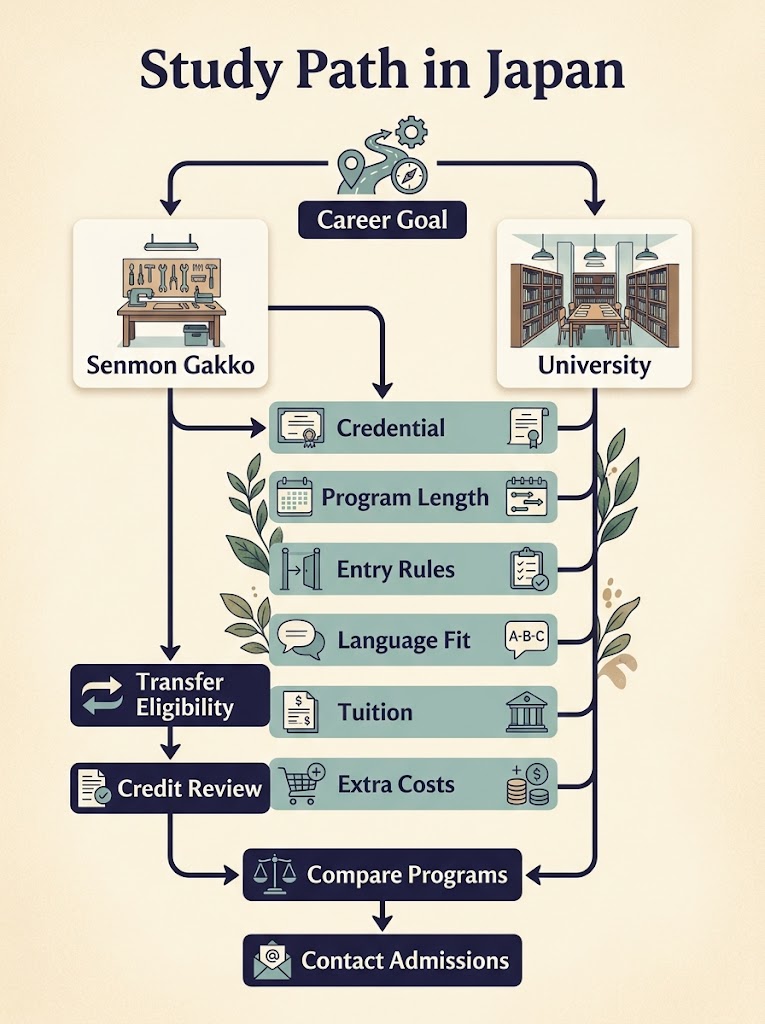
The better option depends on your goals. This comparison explains how practical training, credentials, Japanese-language ability, tuition, and future study differ, including what transfer eligibility does and does not promise. Use these points to decide whether a focused vocational program or a university degree better fits your intended field and next step.
- Senmon Gakko Vs University In Japan: Which Should You Choose?
- Compare Senmon Gakko And University Credentials And Program Length
- Check Senmon Gakko And University Admission And Language Requirements
- Compare Senmon Gakko And University Tuition In Japan
- Understand University Transfer From A Specialized Training College
- Choose A Senmon Gakko Or University Based On Your Career Plan
- Conclusion
- Sources and Further Reading
- Frequently Asked Questions
Senmon Gakko Vs University In Japan: Which Should You Choose?
Choose Senmon Gakko For Focused, Job-Related Training
Senmon gakko usually means a professional training college (専門学校), not every institution with “college” or “academy” in its English name. Its postsecondary professional training college course (専修学校の専門課程) is a higher-education option focused on preparation for a particular kind of work. The focus is practical. Programs span fields such as industry, medical care, commercial practice, education and social welfare, and culture.
That structure can suit a student who already has a clear occupational direction and wants classes tied closely to the field. Depending on the program, learning can center on skills and professional knowledge used in that occupation rather than a wide range of general academic subjects. A student interested in a specific technical, care, or creative career may find this focus more relevant than a broad undergraduate course.
A focused course is not automatically the best route to a job or a higher salary; outcomes depend on the field, school, and employer expectations. Its credential is not the same as a university bachelor’s degree, so the distinction can matter when a job listing or later study plan specifies a degree. Write down your intended career and the credential employers in that field expect.
Choose University For Academic Breadth And A Bachelor’s Degree
University (大学) offers a broader academic route, usually combining study within a major with subjects and methods that extend beyond one occupation. A standard undergraduate university program takes four years and awards a bachelor’s degree (学士), according to Study in Japan. This route may suit students who want deeper subject study, room to explore related interests, or a credential relevant to roles that explicitly require a bachelor’s degree.
A university degree can provide a wider academic foundation, but it does not by itself teach every job-specific skill. For example, someone aiming for a profession with specialized technical procedures may still need practical preparation alongside academic study. Conversely, students whose goals are still taking shape may value the chance to study beyond a single occupational task. The balance between theory and applied work varies by program.
Choose the route that fits your career goal: senmon gakko is more directly organized around occupational preparation, while university centers on a bachelor’s-level academic program. The labels alone do not show how much hands-on work, internship access, or subject choice a particular program provides. Individual curricula vary, so these broad categories are a starting point rather than a complete measure of course quality.
| Item | Senmon gakko | University |
|---|---|---|
| Main purpose | Focused, job-related training | Broader academic study |
| Typical program length | 2–3 years for a diploma; 4 for an advanced diploma | 4 years for a standard undergraduate program |
| Credential | Diploma or advanced diploma | Bachelor’s degree |
| Likely fit | Clear occupational direction | Broader or degree-focused academic goals |
The main difference is the course focus: senmon gakko centers on preparation for specific work, while university offers a broader academic program. The typical lengths also show that a shorter course is not simply a shorter version of a bachelor’s degree; each route leads to a different credential.
This comparison suggests weighing the qualification and learning style alongside the time involved. Program details vary, so the table is a guide to the broad options, not a substitute for the curriculum and credential information for an individual course.
Compare Senmon Gakko And University Credentials And Program Length
What A Professional Training College Diploma Represents
In Japan, senmon gakko commonly refers to a professional training college (専門学校), while the formal postsecondary category is a professional training college course (専修学校の専門課程). This course belongs to the specialized training college (専修学校) system, which is classified as higher education. Its diploma is a vocational credential for completing a recognized course, not the name of a university degree.
A qualifying professional training college diploma course requires at least two years of study and 62 credits, according to the Study in Japan Official Website. Graduates of qualifying recognized courses receive the professional title (専門士). This title confirms completion of a prescribed postsecondary vocational program; it does not turn the course into a university program or award a bachelor’s degree. The distinction matters when an application asks for a specific degree level.
The word diploma can be understood differently across countries, so compare the formal credential rather than relying only on an English brochure label. These are different credentials, not interchangeable awards. Confirm the exact credential and official recognition of the course you are considering.
| Program | Typical minimum length | Minimum credits | Credential |
|---|---|---|---|
| Diploma course | At least 2 years | 62 | Professional title (diploma) |
| Advanced diploma course | At least 4 years | 124 | Advanced professional title |
| Standard undergraduate university program | 4 years | Not specified here | Bachelor’s degree |
The Study in Japan Official Website gives minimum length and credit requirements for professional training college diploma and advanced diploma courses. It describes the standard undergraduate university program as four years and says it awards a bachelor’s degree.
The table shows why time in school is not enough to compare qualifications: an advanced diploma course and a bachelor’s program can both take four years, yet they award different credentials. Compare the award and its recognition as well as the duration.
How An Advanced Diploma Differs From A Bachelor’s Degree
An advanced diploma comes from a longer professional training college course. According to the Study in Japan Official Website, a qualifying advanced diploma course requires at least four years of study and 124 credits. Graduates of qualifying advanced courses receive the advanced professional title (高度専門士). That is a separate credential. Its longer duration and higher credit requirement do not make it a bachelor’s degree.
A standard undergraduate university (大学) program takes four years and awards a bachelor’s degree (学士), according to the Study in Japan Official Website. The duration of that program matches the minimum length of an advanced diploma course, but the awards remain distinct. A course’s length or credit total alone does not change its credential into a university degree.
For applications, the distinction is more useful than comparing course length alone. A university award is a bachelor’s degree, while a professional training college course awards a professional title when it meets the recognition requirements. If you need a credential for further study or a specific job, check how the receiving institution or employer describes the qualification it accepts. The course name by itself may not answer that question.
Check Senmon Gakko And University Admission And Language Requirements
Compare Education Eligibility And School-Specific Admission Rules
Your school-leaving record affects which route is open, but the entry rules are not identical. For a standard undergraduate university program, the Study in Japan official guidance generally requires 12 years of formal education or an accepted equivalent. Applicants from education systems with fewer years may need designated preparatory education. This is general eligibility guidance, not a promise that a specific university will admit an applicant. A school-leaving certificate alone may not show how many years of formal education a university recognizes.
At a professional training college, the relevant option is the postsecondary course at a specialized training college, commonly called a senmon gakko. Official guidance classifies this course as higher education, but a school’s name alone does not establish that it offers this course. Prior education and selection conditions should be considered against the specific program’s published rules, rather than assumed to match university requirements.
Details vary by school. A sound comparison considers the exact course, not only the institution’s English name: a school using “college” or “academy” may not offer the postsecondary professional training college course relevant here. The broader specialized training college category includes courses beyond this postsecondary route, so the course classification matters when comparing options.
Check Japanese Ability And English-Taught Program Availability
Language can be the deciding factor even when a program’s subject fits your goals. Professional training college classes are conducted in Japanese, according to the official Study in Japan guidance. The guidance lists several ways applicants may demonstrate Japanese ability, including JLPT N1 or N2, but accepted evidence and thresholds can depend on the school. Passing a test alone does not establish admission.
University study offers a different language possibility: some Japanese universities teach undergraduate degree programs entirely in English. The official guidance does not list fully English-taught programs at specialized training colleges, so a senmon gakko course should not be assumed to offer the same option. An English-medium degree describes the language of instruction; it does not, by itself, show whether an applicant meets that program’s admission rules. The program description provides those details.
Ask each admissions office for its current entry requirements, language evidence, and available language support. A clear answer should identify the language used in teaching and whether support is available before or during the course. This distinction helps separate formal eligibility from the language ability needed to follow lessons. Those are related, but not identical, questions.
Compare Senmon Gakko And University Tuition In Japan
Compare First-Year Average Fees By School Type
Cost can shape the choice, but the lowest headline figure does not always mean the lowest full-year bill. The Study in Japan Official Website lists first-year averages of about ¥1.3 million for specialized training colleges, ¥820,000 for national universities, and ¥910,000 for local public universities. Private universities average about ¥1.3 million, excluding medical, dental, and pharmaceutical programs. These figures compare school types, not individual offers.
First-year averages are not school quotes. The specialized training college average is close to the private university average, while national and local public university averages are lower. That does not mean every vocational course costs more than every university course: fees differ by institution and field. Treat the chart as a broad starting point, not a prediction of your bill.
For example, a student choosing between a design course at a private university and a vocational course should compare the exact programs, not assume the school category settles the decision. The reported averages cover first-year fees, not every cost over the full program. A shorter course may have a different total cost from a four-year degree, so first-year figures alone cannot show which path costs less overall.
The averages show a lower first-year figure for national and local public universities than for specialized training colleges and the listed private universities. The specialized training college average is similar to the private university average, so the school category alone does not determine which program costs less.
These are broad averages, not current quotes for specific schools, and the cited fee table has no stated publication date. They also do not represent the full cost of a program. The figures are most useful as an initial comparison before considering each course’s required charges.
Check For Materials, Practical Training, And Other Extra Fees
A first-year average does not necessarily include every charge a student will face. The official fee table gives average figures, not a complete school-by-school breakdown, and its publication date is not stated in the cited guidance. Current fees can differ from those averages. The final amount also depends on what each school includes in its tuition and admission fees, and how it bills course-related costs.
Small charges add up. Depending on the field, a program may require materials, equipment, or practical training costs that are not included in the headline figure. For instance, a course with hands-on work may have expenses that a classroom-focused program does not. The size and timing of these costs vary by school, so two programs with similar tuition can still have different first-year totals.
Request an itemized fee estimate from each school, including costs beyond tuition and admission fees. A useful estimate separates the required charges by category and indicates when each is due, making it easier to compare the full first-year cost. It can also clarify whether the published average is close to that school’s current charges or only a broad reference point.
Understand University Transfer From A Specialized Training College
Check Whether Your Course Qualifies You To Apply For Transfer
A school’s name alone does not show whether its course qualifies for university transfer. The relevant route is a postsecondary professional training college course (専修学校の専門課程), not every program offered by an institution described in English as a college, academy, or vocational school. The legal eligibility applies to graduates of qualifying courses, rather than automatically to every student enrolled in vocational study. That distinction matters.
MEXT says graduates of qualifying specialized training college postsecondary courses can be eligible to apply for university transfer (編入学) under Japanese law. This is a route into a later year or stage of another school’s program, rather than a guarantee of a place. The word “eligible” describes permission to apply; it does not mean that every course, applicant, or destination university meets the relevant conditions. The route concerns a qualifying course, not a general right to move from any vocational school into a university program.
A course may be described as vocational or professional training without necessarily having the status needed for this pathway. The key issue is not whether the school teaches practical skills, but whether the specific postsecondary course is recognized as qualifying for transfer eligibility. Its course type and credential description are useful clues, but neither should be treated as proof that a university will accept an application. This eligibility route is narrower than the everyday meaning of vocational school, which can include programs at different levels.
Confirm Transfer Admission And Credit Recognition Directly With The University
Even when a course qualifies, universities set their own transfer admission policies. MEXT’s guidance establishes that eligible graduates may apply, while leaving the receiving university’s admission decision separate. Some universities accept transfer applicants and others do not; an eligible applicant can still be refused, or may find no suitable transfer route for the intended subject. In short, eligibility is not a guarantee of admission.
Transfer requirements can differ by university and program, including the stage at which a student may enter and the application documents or examinations required. Contact the target university’s admissions office with the vocational course name and curriculum before enrolling. That inquiry can clarify whether the school considers the course eligible, whether transfers are open for the intended program, and which published requirements apply.
Credit recognition is a separate question from admission. A university may admit a transfer applicant without accepting all previous coursework as equivalent, so admission does not automatically mean the student can skip the same amount of study. The receiving university decides how prior learning fits its program, and transfer placement should not be assumed from the vocational diploma alone. These details can affect both the student’s entry point and the study remaining after a successful application.
Choose A Senmon Gakko Or University Based On Your Career Plan
Match Your Intended Field To The Program’s Training And Curriculum
The right choice depends on the work you want to do, not on which school type sounds more prestigious. The daily work differs. A professional training college course is designed around a specialized field, while a university program can include broader academic study alongside a major. Japan’s professional training colleges cover fields such as industry, medical care, commercial practice, and culture and liberal arts.
Match the credential to the role before comparing school labels. A job posting or employer’s stated requirements can show whether a bachelor’s degree, a practical qualification, or a portfolio is expected; these expectations vary by occupation and employer. A university degree can suit a path that values a broad academic foundation, while focused vocational study can fit a defined occupation if the course teaches skills used in that field.
Language and future study plans matter, too. Professional training college classes are conducted in Japanese, so a course may be a poor fit if you are not ready to study technical material in Japanese. Some Japanese universities teach undergraduate degrees entirely in English. If further study is part of your plan, compare the credential each program awards with the entry conditions for the next course.
Verify Course Recognition, Outcomes, And Application Details
Names alone are not enough. The school’s exact course and its official status matter because a professional title is granted only to graduates of qualifying courses. MEXT guidance also allows graduates of qualifying postsecondary specialized training college courses to apply for university transfer, but eligibility does not guarantee admission. A program’s advertised subject or school name by itself does not establish that it qualifies.
Look beyond promotional descriptions when considering career outcomes. Course details can show how much time is devoted to specialist subjects, practical work, and general study, while published graduate information may help you assess the paths graduates take. Neither a course title nor a list of employment examples guarantees a particular result. If an employer or later school requires a specific credential, its stated requirements are especially relevant.
Shortlist programs in your field and compare their curriculum, credential, language conditions, and itemized costs. Application calendars, entrance tests, and document rules are set by individual schools, so the details can differ even between courses in the same field. Current admissions information from each school is the reference for planning an application. This comparison can reveal whether a course fits your career goal, language readiness, and plans for further study.
Conclusion
Think of senmon gakko vs university as choosing the preparation that best supports the work and qualification you want, not deciding which institution ranks higher.
For a simple first step, compare the curriculum and admissions requirements of one program from each route in your intended field. Let the details speak.
Sources and Further Reading
- Study in Japan Official Website — www.studyinjapan.go.jp
- Study in Japan Official Website — studyinjapan.go.jp
- Study in Japan Official Website — studyinjapan.go.jp
- Study in Japan Official Website — www.studyinjapan.go.jp
- Ministry of Education, Culture, Sports, Science and Technology — www.mext.go.jp
- professional title (diploma) — www.mext.go.jp
Frequently Asked Questions
- QIs a senmon gakko diploma the same as a Japanese university bachelor’s degree?
- A
No. A qualifying professional training college course can award a diploma or advanced diploma, while a standard four-year undergraduate university program awards a bachelor’s degree.
These are different credentials. Check the exact title awarded by the course you are considering.
- QCan I study at a senmon gakko in Japan in English?
- A
Official Study in Japan guidance lists undergraduate university programs taught entirely in English, but does not list equivalent programs at specialized training colleges.
Classes at professional training colleges are conducted in Japanese. Confirm the language of instruction and any language requirements directly with each school.
- QCan I transfer from a senmon gakko to a Japanese university?
- A
Yes, graduates of qualifying postsecondary courses can be eligible to apply for university transfer under Japanese law.
Eligibility does not guarantee admission or credit transfer. Each university sets its own transfer rules and decides which credits, if any, it will recognize.
- QHow much does it cost to study at a senmon gakko compared with a university?
- A
According to the Study in Japan Official Website, average first-year fees are about ¥1.3 million at specialized training colleges. The averages for undergraduate universities are about ¥820,000 at national universities, ¥910,000 at local public universities, and ¥1.3 million at private universities, excluding medical, dental, and pharmaceutical programs.
These are averages, not school-specific quotes, and extra fees may apply. Check each school’s current fee schedule before applying.