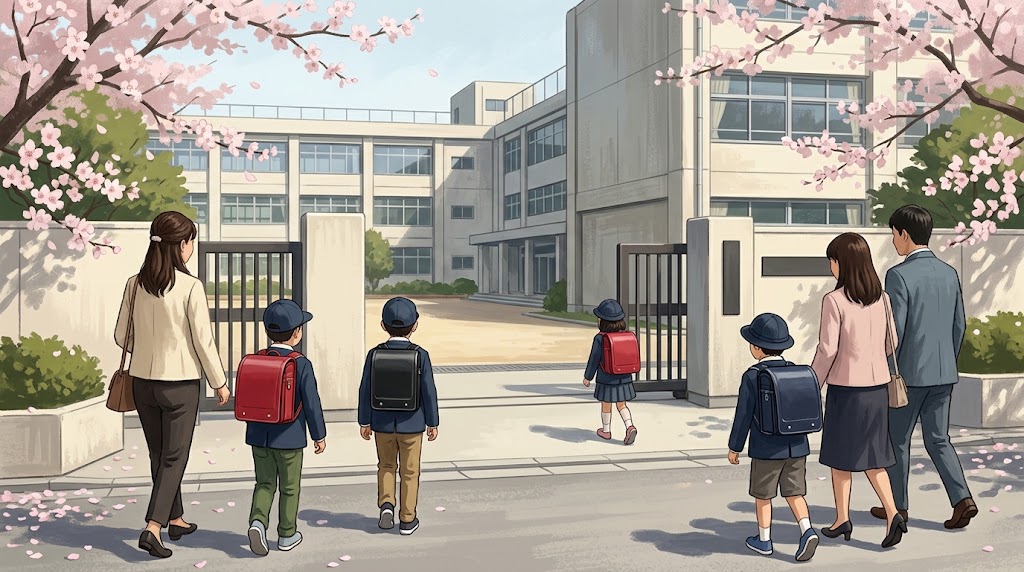
If you are planning a move or study term, Japan’s April school start can affect when you arrive. Why does the Japanese school year start in April? The common explanation is its connection to Japan’s April-to-March fiscal year, not cherry blossoms alone.
The change happened gradually, so April did not become the start date for every type of school at once. Some schools and universities use different calendars, including September or October admission options. Knowing the history and the usual school-year pattern can help you distinguish the national norm from the dates that apply to a particular school or program.
- Why Does The Japanese School Year Start In April?
- How The History Of Japan’s School Calendar Unfolded
- How The Japanese School Year Runs From April To March
- Why Local Japanese School Calendars Can Differ
- Can You Start A Japanese University In September?
- What Overseas Students And Families Should Check Before Planning
- Conclusion
- Sources and Further Reading
- Frequently Asked Questions
Why Does The Japanese School Year Start In April?
The Commonly Cited Link To Japan’s Fiscal Year
A commonly cited explanation is that Japan’s school year became aligned with the government’s fiscal year, the annual period used for government budgeting and accounting. According to Japan’s Ministry of Finance, that fiscal year runs from April 1 through March 31 of the following year. Starting school in April places its annual cycle alongside that government calendar. That link is not the whole story.
The fiscal-year connection helps explain why April became an established start date, but it does not mean every school changed at the same time. A National Diet Library reference lists alignment with the government’s fiscal year among several explanations for early April adoption. When comparing calendars, check whether the institution’s year runs alongside Japan’s April-to-March fiscal year. This distinction is useful when a school or program has its own schedule.
Why The Start Date Was Not A Single National Switch
The shift took time. A National Diet Library reference says many schools in the early Meiji period began their academic year in September, showing that April was not always the standard. Institutions later adopted April at different points, and the change spread across school types over time. The history is therefore better understood as a gradual move than as one nationwide switch.
The sources describe separate milestones for teacher-training schools, elementary schools, and higher institutions, rather than a single date when every school changed. A separate library reference places the government’s decision to begin the elementary-school year in April in 1900. The House of Representatives record describes later transitions for old-system high schools and imperial universities. April became the broad pattern through successive changes.
How Cherry Blossoms Became Associated With School Beginnings
Cherry blossoms help explain why April school beginnings are so familiar in Japanese images and seasonal references. Spring is strongly associated with new beginnings, and school entrance ceremonies are often linked with that season. The flowers make the start of a school year feel visually connected to renewal. This is a cultural association, not the original administrative reason for choosing April.
The timing and the symbolism are related, but they answer different questions. The fiscal-year link helps explain the calendar’s historical development, while cherry blossoms provide a seasonal backdrop for ceremonies and other school-year imagery. Kids Web Japan describes the cultural connection between spring, blossoms, and new beginnings. In short, blossoms reinforce the April association; they do not explain why the calendar first shifted.
How The History Of Japan’s School Calendar Unfolded
Some Schools Began The Year In September
The history did not begin with a uniform April calendar. A National Diet Library reference entry says many schools in the early Meiji period started their academic year in September, so April was not always the norm. The record establishes that September starts existed, but it does not give one date when every school followed the same schedule.
That early variety matters because the familiar April-to-March calendar developed over time. It is easy to picture the current school year as an old national tradition, but the historical record points to changes among different types of schools. September starts are part of that history, not an exception to an unchanging rule. April adoption spread across school types.
Teacher-Training Schools Adopted April Starts In The 1880s
The first documented April adoptions in the timeline involved teacher-training institutions. According to the National Diet Library, the Higher Normal School (高等師範学校) adopted an April start in 1886, followed by prefectural normal schools (府県立尋常師範学校) in 1888. These milestones show April taking hold in particular institutions, rather than an immediate change for all schools.
The library reference lists several explanations for the early shift, including alignment with the government fiscal year (会計年度). Japan’s Ministry of Finance defines that year as running from April 1 to March 31 of the following year. This link helps explain why April was administratively useful, but it should not be treated as the only reason or as proof that every school changed at once. The timing differed by school type.
Elementary Schools And Higher Institutions Changed Later
Elementary schools and higher institutions changed on separate timelines. A separate National Diet Library reference summarizes sources that place the government’s decision to begin the elementary-school year in April in 1900. That milestone came after the teacher-training schools’ changes in the 1880s, showing that April adoption continued to spread rather than happening in one national switch.
The transition also reached higher institutions later. A 2020 record from Japan’s House of Representatives describes old-system high schools moving from September to April in 1919, followed by imperial universities in 1921. These dates refer to specific school types, not every institution in Japan. Use the timeline to distinguish early April adoption from later changes across school types. That is the clearest way to read the sequence.
The chart shows the order of milestones, not the number of schools affected or the length of each transition. The early Meiji entry has no specific year in the cited reference, so it is placed first without assigning it a date.
The sequence moves from teacher-training schools to elementary schools and then higher institutions. Read each label as a change for that school type, not as evidence of one nationwide start-date change.
How The Japanese School Year Runs From April To March
The Usual April-To-March Academic Year
Japan’s standard school calendar is not arranged around the calendar year used in many countries. According to Japan Educational Travel, the Japanese school year, or academic year, runs from April through March of the following year. In short, the academic year runs from April through March, rather than following a January-to-December cycle. A student moving between school systems may find that the school year does not align with the months used at home.
This pattern describes the usual framework, not a promise that every school holds classes on identical dates. Schools set their own calendars within the broader April-to-March year, so the first and last days of classes can differ. The dates are not identical everywhere. For families comparing school systems, the distinction is between the academic year itself and the specific dates on a school’s calendar.
How Three School Terms Divide The Calendar
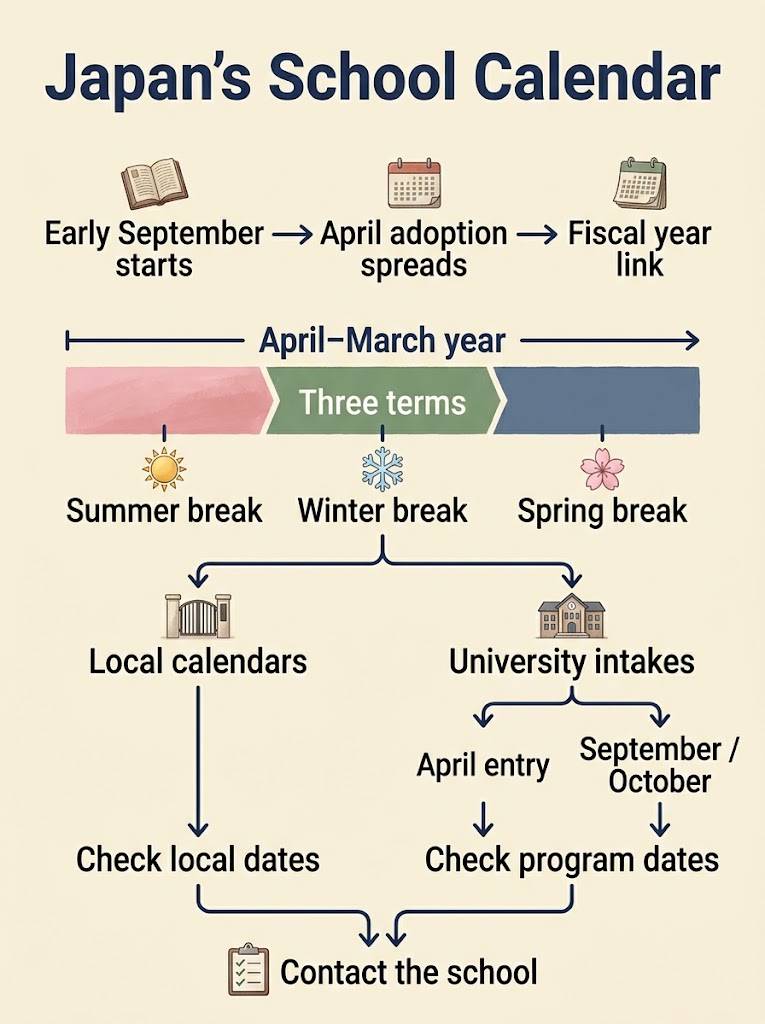
Many Japanese schools divide the year into three terms. Japan Educational Travel describes a common pattern: the first term runs from April to August, the second from September to December, and the third from January to March. The periods follow the April-to-March academic year, but they do not mean every school uses the same term dates. Local calendars may set different dates for the start and end of each term.
The three-term pattern gives students and families a broad guide to the school year, while the published calendar gives the dates that apply to a particular school. Three terms are common, not universal. Compare your school’s published term dates with this common April-to-March pattern before making plans. The table shows the general sequence and where summer, winter, and spring breaks fit around the terms.
| School period | Common months | Break shown around the period |
|---|---|---|
| First term | April to August | Summer break after the term |
| Second term | September to December | Winter break after the term |
| Third term | January to March | Spring break after the school year |
The table summarizes a common three-term pattern described by Japan Educational Travel. It places each break near the end of a teaching period, but it does not give exact dates or lengths. Those details are not identical across schools.
Use the table as a broad calendar guide, rather than a booking schedule. A school’s published calendar is the relevant source for its term boundaries and break dates, especially when coordinating a move, enrollment, or travel.
When Summer, Winter, And Spring Breaks Usually Fall
Summer, winter, and spring breaks are arranged around the terms, rather than forming one long holiday. Japan Educational Travel describes summer break around the period after the first term, winter break around the end of the second, and spring break around the end of the third. Breaks sit between teaching periods. The exact dates and lengths are not specified by this common pattern and can differ between schools.
For a student joining a school midyear, the break pattern can help explain why a move in one season may fall near a term boundary. It does not, by itself, establish when classes resume or how long a holiday lasts. A school’s own calendar is the useful reference for those details. The April-to-March pattern is a starting point for understanding the year, not a substitute for a local schedule.
Why Local Japanese School Calendars Can Differ
Boards Of Education Set School-Management Rules
An April start does not mean every school follows identical dates. The Embassy of Japan in the United States explains that boards of education set school-management rules, including the school year and terms. Those rules shape calendars for local schools, so local school calendars can differ. The national April-to-March pattern is useful context, but it does not provide the exact first day or break dates for every school.
A school may follow the national academic-year pattern while its local schedule sets the exact boundaries of each term and break. These are related but separate details: the academic year identifies the broad period, while a school calendar shows when that school’s classes and breaks fall. For a family comparing schools in different municipalities, an April start alone does not settle the practical timing or show whether both schools share the same term dates.
That matters when a move or enrollment is planned around a particular week. For example, a family arriving in a new city might expect a break based on a calendar seen elsewhere, only to find that the relevant school has published different dates. The details can differ. Treat a calendar as specific to the board or school named on it, rather than as a schedule that automatically applies across Japan.
What To Confirm With A Local School
A useful starting point is the distinction between the calendar for a child’s actual school and a general description of the Japanese school year. Check the relevant board of education or school calendar for the exact start, term, and break dates. This gives you dates tied to that local arrangement, rather than an estimate based on the national April-to-March framework. The same distinction matters to students whose schedules depend on a particular institution.
A calendar is useful for more than the first day of classes. The start of the academic year, the beginning and end of each term, and scheduled breaks answer different planning questions. A published calendar may name the school year it covers, which helps distinguish it from an older schedule. If the school provides its own calendar, the key detail is whether it applies to the student’s school and program.
For a traveler, break dates can affect whether a visit coincides with classes or time off; for a relocating family, they can shape the arrival date and transition into school. These are planning consequences, not evidence that every area uses a different structure. When a calendar is unclear, the school or board is the source for the arrangement it administers. A schedule for one area may not apply to another.
Can You Start A Japanese University In September?
Some Universities Offer September Or October Admission
Japan’s usual April-to-March academic year does not mean every university course begins in April. Some universities offer September or October admission, creating entry points outside the standard spring cycle. The Study in Japan guide from the Japan Student Services Organization describes these options, especially at graduate schools. Admission dates vary by program.
A fall intake may suit applicants whose previous studies follow a different academic calendar, but the available courses and application schedule depend on the institution. Application deadlines, orientation, and course registration may also follow a separate timeline. Compare the intake dates for your specific program rather than relying on Japan’s usual school-year start. Confirm current details on the university’s official admissions page before applying.
| Calendar or example | What the source indicates |
|---|---|
| General school-year pattern | April through March |
| Some university programs | September or October admission is available |
| Waseda SILS, 2027 admissions | April and September entry routes |
The general April-to-March pattern describes the usual school year, not a universal university intake date. The September and October options are offered by some universities, with the Study in Japan guide noting graduate schools in particular.
Waseda SILS provides a specific example of both April and September entry for its 2027 admissions. These differences show why a national calendar alone cannot identify the right start date for an individual program.
Graduate-School Options May Differ From Other Programs
The national school-year pattern does not establish a single start date for every graduate program. The Study in Japan guide says some universities, particularly graduate schools, offer September or October admission. That is an option, not a guarantee across all fields or institutions. A university may have different entry terms for different programs.
A graduate school’s schedule can differ from the undergraduate calendar at the same university. The relevant details are the intake term offered by the specific program and the application schedule attached to it. For example, a university may have a fall entry route for one program while another follows an April start. Check the program’s own admissions information, since a university-wide calendar may not describe every course.
Some Universities Offer Both April And September Entry
Some institutions list more than one entry point. For its 2027 admissions, Waseda University’s School of International Liberal Studies lists both April and September entry routes. This is a concrete example of a university offering alternatives to a single spring start. It does not establish that other universities, or other programs at Waseda, use the same arrangement.
The two routes can make a difference when you plan your application and transition into study, but their requirements and schedules may not be identical. The listed entry options relate to a particular school and admissions cycle, rather than a nationwide university rule. Since admissions information can change, use the institution’s official page for the current details before making plans.
What Overseas Students And Families Should Check Before Planning
Confirm The Institution’s Start Date And Admissions Calendar
An April-to-March school year is the usual pattern in Japan, but it does not tell you when a particular program admits students. Before choosing flights, housing, or a work transition, distinguish the academic year from the application deadline, orientation, and first day of classes. These dates can fall at different times, and some universities offer September or October admission. Confirm the calendar that applies.
The Study in Japan guide says some universities, especially graduate schools, offer September or October admission. Waseda University’s School of International Liberal Studies lists both April and September entry routes for its 2027 admissions. These examples show why the university-wide calendar may not answer questions about a specific course. Application deadlines and entry options depend on the program, so published details for one department may not apply to another.
Check Local Term Dates And Breaks Before Booking Travel
A general school calendar cannot give you the exact dates for a local term or break. Japan National Tourism Organization describes a common three-term pattern: April to August, September to December, and January to March, with summer, winter, and spring breaks around those periods. Local schools set their own calendars, so the dates of term endings and vacation periods can differ. Breaks are not identical.
Those differences can affect arrival plans, childcare, and the timing of a family move. A school break may not match a university vacation or an employer’s leave period, even when each follows an April-to-March year. Booking travel around a broad seasonal label such as “spring break” can therefore leave a gap between arrival and the start of classes. Check the published calendar for the specific school year, since dates can change.
Ask The School Or Program Which Calendar Applies
If you are coordinating with a school from overseas, it may be unclear whether a national pattern or a local schedule governs your plans. The Embassy of Japan in the United States explains that boards of education set school-management rules, including school years and terms, as of June 3, 2025. Local arrangements matter. This is especially relevant when a family is moving between municipalities or comparing a public school with a private or international program.
Contact the school or program directly to confirm its intake, term dates, and applicable local calendar before booking travel. The key details are whether the schedule applies to your child’s grade or your chosen course, and whether entry means orientation or the first day of regular classes. Where more than one calendar is published, ask which one covers your enrollment. A clear answer can help coordinate travel and housing without assuming every institution follows the same dates.
Conclusion
Asking why does the Japanese school year start in April offers a view of how education fits into Japan’s broader administrative rhythm. April is a useful reference point, but it cannot predict every institution’s schedule.
Before making plans, take a moment to check the calendar for the school or program you have in mind. The right date puts everything else in place.
Sources and Further Reading
- Japan Educational Travel, Japan National Tourism Organization — education.jnto.go.jp
- Ministry of Finance, Japan — www.mof.go.jp
- National Diet Library Reference Cooperative Database — crd.ndl.go.jp
- National Diet Library Reference Cooperative Database — crd.ndl.go.jp
- House of Representatives of Japan — www.shugiin.go.jp
- Embassy of Japan in the United States of America — www.us.emb-japan.go.jp
- Kids Web Japan, Web Japan — web-japan.org
- Study in Japan, Japan Student Services Organization — www.studyinjapan.go.jp
- School of International Liberal Studies, Waseda University — www.waseda.jp
- Elementary School Order — www.archives.go.jp
Frequently Asked Questions
- QIs the Japanese school year always April to March?
- A
Usually, yes: the standard school year runs from April to March. It is not universal.
Local school arrangements can differ, and some higher-education programs use other admission dates. Check the school or program calendar for the dates that apply to you.
- QDid Japan choose April because of cherry blossoms?
- A
No. The historical explanation commonly points to aligning the school year with Japan’s April-to-March fiscal year.
Cherry blossoms reinforce the association between spring and new beginnings, including school entrance ceremonies. That cultural connection is distinct from the fiscal-calendar explanation.
- QDo Japanese universities accept students in September?
- A
Yes, some universities and programs offer September admission, and some offer October admission. The Study in Japan guide notes that these options include some graduate schools.
Admission dates depend on the program. Check its official admissions calendar before applying, since the available intakes can differ.
- QHow many terms are in a Japanese school year?
- A
Many schools use three terms, according to Japan Educational Travel, a Japan National Tourism Organization resource. The usual divisions are April to August, September to December, and January to March.
Summer, winter, and spring breaks fall around these terms, but exact calendars can vary by school or area. Confirm dates with the school before planning travel.